Inside A
Black Hole
Structure, physics and extreme phenomena
Anatomy of a Black Hole
Event Horizon
This is what makes a black hole black. We can think of the event horizon as the black hole’s surface. Inside this boundary, the velocity needed to escape the black hole exceeds the speed of light, which is as fast as anything can go. So whatever passes into the event horizon is doomed to stay inside it – even light. Because light can’t escape, black holes themselves neither emit nor reflect it, and nothing about what happens within them can reach an outside observer. But astronomers can observe black holes thanks to light emitted by surrounding matter that hasn’t yet dipped into the event horizon.
Accretion Disk
The main light source from a black hole is a structure called an accretion disk. Black holes grow by consuming matter, a process scientists call accretion, and by merging with other black holes. A stellar-mass black hole paired with a star may pull gas from it, and a supermassive black hole does the same from stars that stray too close. The gas settles into a hot, bright, rapidly spinning disk. Matter gradually works its way from the outer part of the disk to its inner edge, where it falls into the event horizon. Isolated black holes that have consumed the matter surrounding them do not possess an accretion disk and can be very difficult to find and study.
Event Horizon Shadow
The event horizon captures any light passing through it, and the distorted space-time around it causes light to be redirected through gravitational lensing. These two effects produce a dark zone that astronomers refer to as the event horizon shadow, which is roughly twice as big as the black hole’s actual surface.
Photon Sphere
From every viewing angle, thin rings of light appear at the edge of the black hole shadow. These rings are really multiple, highly distorted images of the accretion disk. Here, light from the disk actually orbits the black hole multiple times before escaping to us. Rings closer to the black hole become thinner and fainter.
Doppler Beaming
Viewed from most angles, one side of the accretion disk appears brighter than the other. Near the black hole, the disk spins so fast that an effect of Einstein’s theory of relativity becomes apparent. Light streaming from the part of the disk spinning toward us becomes brighter and bluer, while light from the side rotating away becomes dimmer and redder. This is the optical equivalent of an everyday acoustic phenomenon, where the pitch and volume of a sound – such as a siren – rise and fall as the source approaches and passes by.
Corona
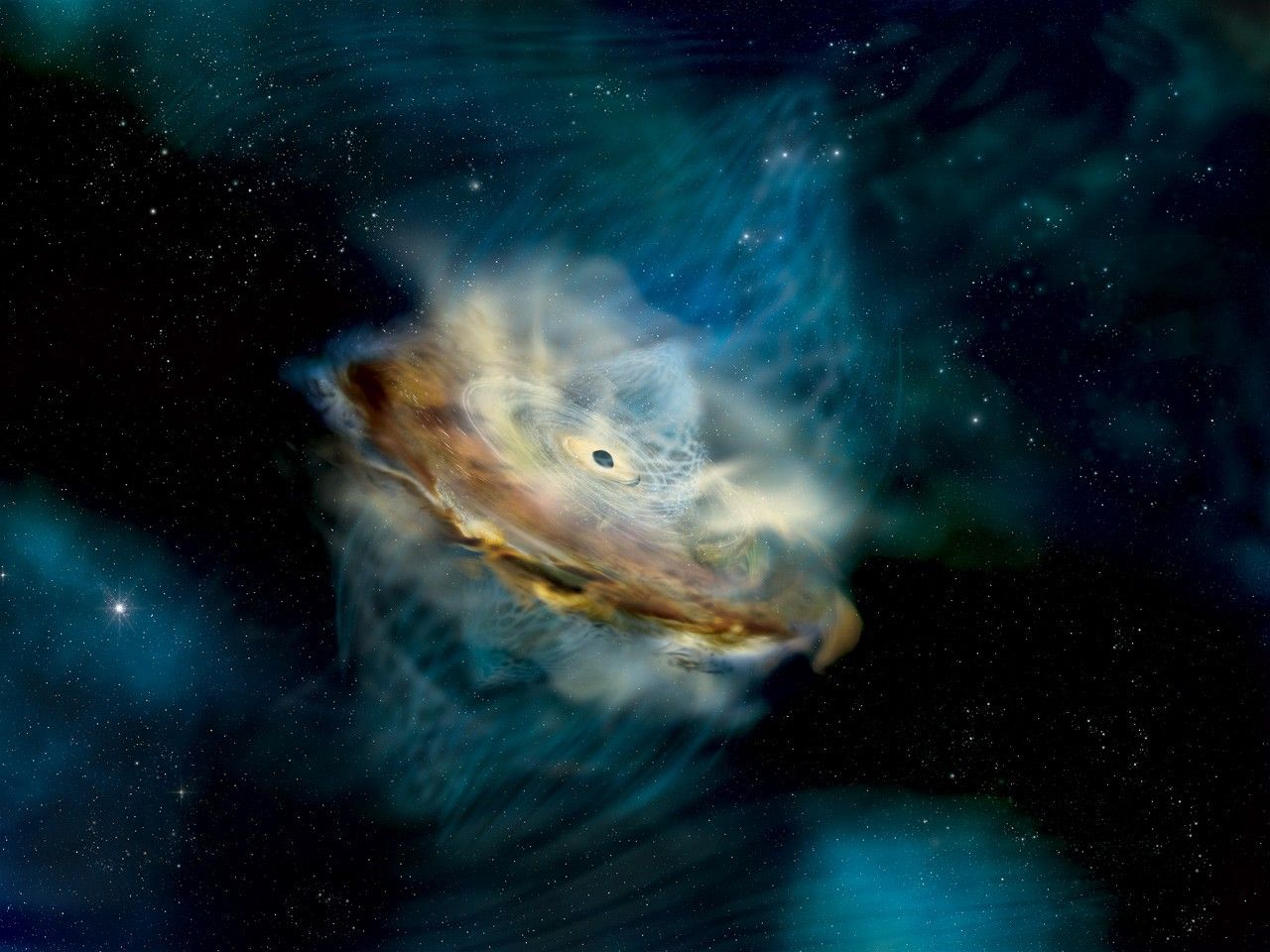
Illustration of a supermassive black hole corona
The corona is among the most extreme environments in the universe — a turbulent, billion-degree cloud shaped by intense magnetic fields.
Particle Jets
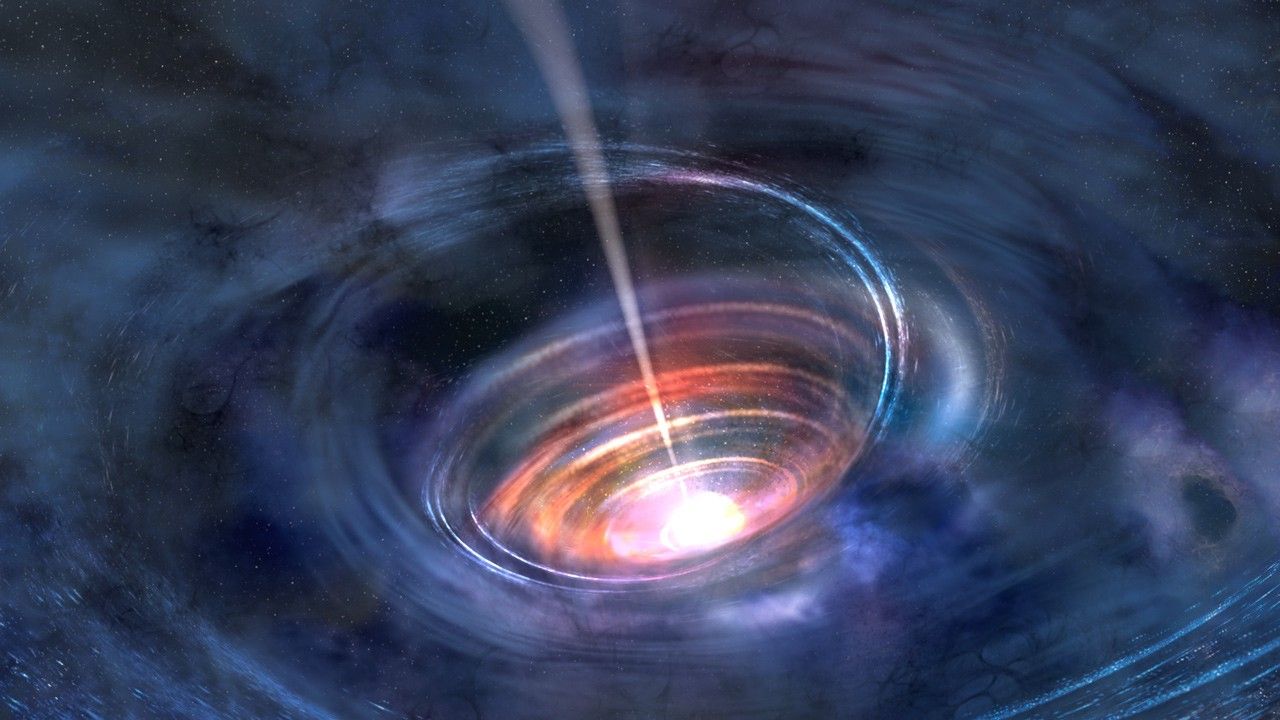
Relativistic particle jets emerging from a black hole
In black holes of all sizes, something strange can occur near the inner edge of the accretion disk. A small amount of material heading toward the black hole may suddenly become rerouted into a pair of jets that blast away from it in opposite directions. These jets fire out particles at close to the speed of light, but astronomers don’t fully understand how they work. The jets from supermassive black holes can reach lengths of hundreds of thousands of light-years.
Singularity
General relativity predicts that the very center of a black hole contains a point where matter is crushed to infinite density. It’s the final destination for anything falling into the event horizon. The singularity may be either a physical structure or a purely mathematical one, but right now astronomers don’t know which is true. The prediction of a singularity may signal the limits of relativity, where quantum effects not included in the theory become important in a more complete description of gravity.