Black Hole
Basics
Journey into the darkest mysteries of the universe
◈ Black Holes
Black holes are among the most mysterious objects in space, much studied but not fully understood. These objects aren't really holes. They're huge concentrations of matter packed into very tiny spaces. A black hole is so dense that gravity just beneath its surface, the event horizon, is strong enough that nothing—not even light—can escape. The event horizon isn't a surface like Earth's or even the Sun's; it's a boundary that contains all the matter that makes up the black hole.
There is much we don't know about black holes, like what matter looks like inside their event horizons. However, there is a lot that scientists do know about black holes.
“Black holes are where God divided by zero. They are the universe’s most extreme laboratories, testing our understanding of gravity, space, and time.” — Stephen Hawking, A Brief History of Time
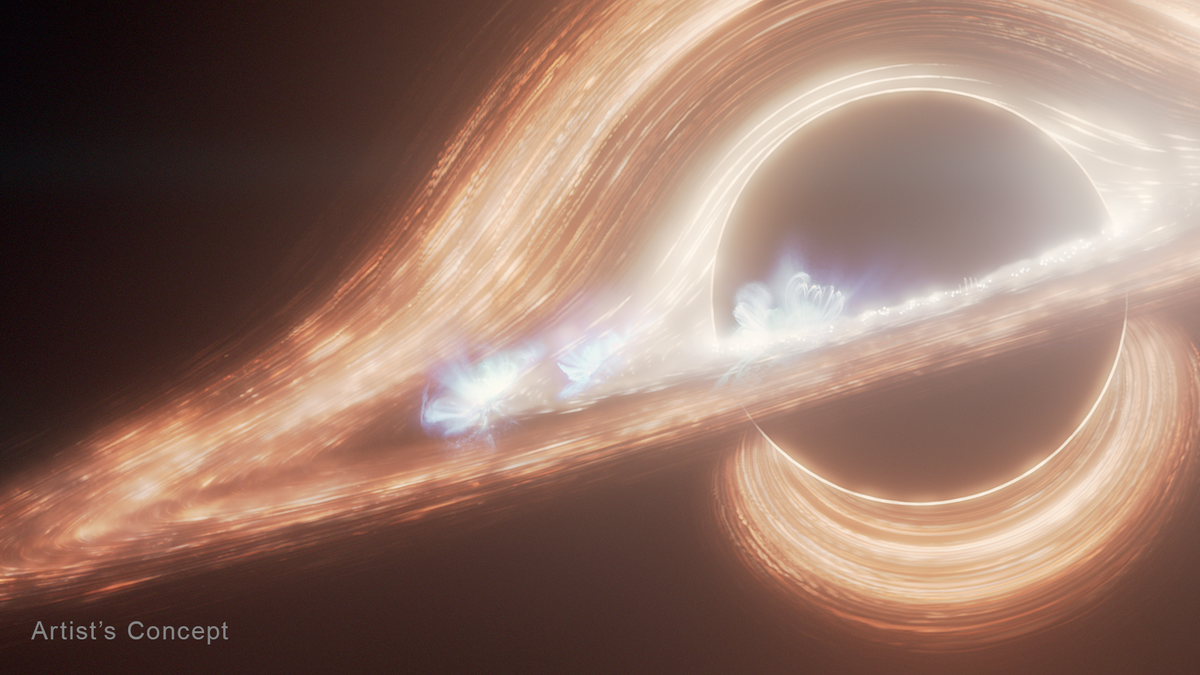
This artist’s concept was created to support the first-ever image of a black hole, called M87*, taken by the EHT. M87* is located in the center of galaxy Messier 87, about 53 million light-years away from Earth. Image first revealed on April 10, 2019.
◈ Finding Black Holes
Black holes don’t emit or reflect light, making them effectively invisible in telescopes. Scientists primarily detect and study them based on how they affect their surroundings:
- Black holes can be surrounded by rings of gas and dust, called accretion disks, that emit light across many wavelengths, including X-rays.
- Supermassive black holes possess gravity that can cause stars to orbit in a particular way. Astronomers tracked orbits of several stars near the centre of the Milky Way to prove it harbours a supermassive black hole—a major result of the 2020 Nobel Prize in Physics.
- When very massive objects accelerate through space, they create ripples in the fabric of space-time called gravitational waves, which can be detected by LIGO detectors.
- Massive objects like black holes can bend and distort light from more distant objects. This effect, called gravitational lensing, can sometimes be used to find black holes that are otherwise invisible.
Detection Methods at a Glance
| Method | What is Detected | Example Mission |
|---|---|---|
| Accretion Disk Emission | X-ray & optical light | Chandra X-ray Observatory |
| Stellar Orbits | Stars moving near galactic centre | Keck Observatory, VLT |
| Gravitational Waves | Spacetime ripples from mergers | LIGO / Virgo |
| Gravitational Lensing | Bent light from background sources | Hubble Space Telescope |
| Direct Imaging | Shadow at event horizon | Event Horizon Telescope |
◈ Black Holes Are Not…
- Wormholes. They don’t provide shortcuts between different points in space, or portals to other universes or dimensions.
- Cosmic vacuum cleaners. Black holes don’t suck in other matter. From far enough away, their gravity is no stronger than that of other objects of the same mass.
- Infinitely small. While the singularity may be a point, the black hole region defined by the event horizon has a definite, calculable size.
- Permanent. Through a quantum process called Hawking radiation, black holes very slowly lose mass and will eventually evaporate over immense timescales.
Key Terms
- Event Horizon
- The boundary surrounding a black hole beyond which no information or matter can escape. It is not a physical surface.
- Singularity
- The centre of a black hole where density becomes theoretically infinite and the known laws of physics break down.
- Hawking Radiation
- Theoretical thermal radiation predicted to be emitted by black holes due to quantum effects near the event horizon, causing them to slowly lose mass.
- Accretion Disk
- A disk of gas, dust, and other material spiralling into a black hole, heated to extreme temperatures and emitting powerful X-ray radiation.
- Spaghettification
- The process by which tidal forces from a black hole stretch an infalling object vertically and compress it horizontally, resembling a strand of spaghetti.
Black Holes Documentary
◈ CLASSIFICATION ◈
Types of Black Holes
| Classification | Mass Range | Formation | |
|---|---|---|---|
| Stellar-Origin | Stellar Black Holes | 3 – 100 M☉ | Collapse of massive stars |
| Intermediate Black Holes | 100 – 100,000 M☉ | Mergers / dense star clusters | |
| Galactic-Scale | Supermassive Black Holes | 106 – 1010 M☉ | Galaxy formation processes |
| Ultramassive Black Holes | > 1010 M☉ | Mergers of supermassive BHs | |
| M☉ = Solar Mass. Boundaries are approximate and subject to ongoing research. | |||
Essential Black Hole Facts
Closest
The nearest known black hole, called Gaia BH1, is about 1,500 light-years away.
Farthest
The most distant black hole detected, at the centre of galaxy QSO J0313-1806, is around 13 billion light-years away.
Biggest
The most massive black hole observed, TON 618, tips the scales at 66 billion times the Sun’s mass.
Smallest
The lightest-known black hole is only 3.8 times the Sun’s mass. It’s paired up with a star.
Spaghettification 🍝
A real term that describes what happens when matter gets too close to a black hole. It’s squeezed horizontally and stretched vertically, resembling a noodle.
Spin ⟳
All black holes spin. The fastest known – named GRS 1915+105 – rotates at over 1,000 rotations per second.
Particle Accelerators ⚡
Monster black holes at the centres of galaxies can launch particles to near light speed.
Gravity’s the Same
If you replaced the Sun with a black hole of the same mass, the solar system would get a lot colder, but the planets would stay in their orbits.
Star Booms 💥
One type of black hole is born when massive stars run out of fuel and explode in supernovae.
Not So Rare
The Milky Way alone likely has numerous black holes near its centre. One is called Sagittarius A* (pronounced ay-star), and it’s 4 million times the Sun’s mass.

◈ Notable Black Holes
| Name | Type | Mass (Solar Masses) | Distance (ly) | Notable Feature |
|---|---|---|---|---|
| Sagittarius A* | Supermassive | 4,000,000 | 26,000 | Centre of Milky Way |
| M87* | Supermassive | 6,500,000,000 | 53,490,000 | First ever imaged (2019) |
| TON 618 | Ultramassive | 66,000,000,000 | 10,400,000,000 | Most massive known BH |
| Gaia BH1 | Stellar | 9.6 | 1,560 | Closest known to Earth |
| GRS 1915+105 | Stellar | ~12 | 36,000 | Fastest-spinning known |
ⓘ Data is approximate. ly = light-years.